source_list.xlsx
stableProject-level XLSX template that registers every bibliographic and archival source behind an EM project. Document nodes in the graph cite it via stable D.NN ids. Stable since EM 1.3, valid for EM 1.4/1.5; a revised two-sheet schema is in preparation for EM 1.6 (DP-58).
Or pick a specific EM version below ↓
What it is
source_list.xlsx is the canonical XLSX template for the
bibliographic and archival source registry of an Extended Matrix
project. It sits at the project root, next to the .graphml, and acts
as the single point of truth for every source the graph cites.
Each row is one source — a publication, an archival document, a
photograph, an analysis report, a 3D survey. Each source receives a
project-local identifier (D.01, D.02, …) that:
- the GraphML’s
Documentnodes reference as their stable id, - the
DosCofolder uses as filename prefix (D.02_excavation_report_1979.pdf), - EMtools and Heriverse pick up at import time to populate the rich metadata of every Document node downstream.
This three-way binding — graph ↔ spreadsheet ↔ DosCo files — is what lets you maintain a project’s bibliography in one place and have it flow into every downstream view (yEd, Blender, the web).
What the schema looks like
The 1.5 stable schema is a single sheet with eight columns:
Name, Description, Url, Property that can validate,
original id., Type, Preview, Notes. Open the empty template
and hover the column headers for per-column help.
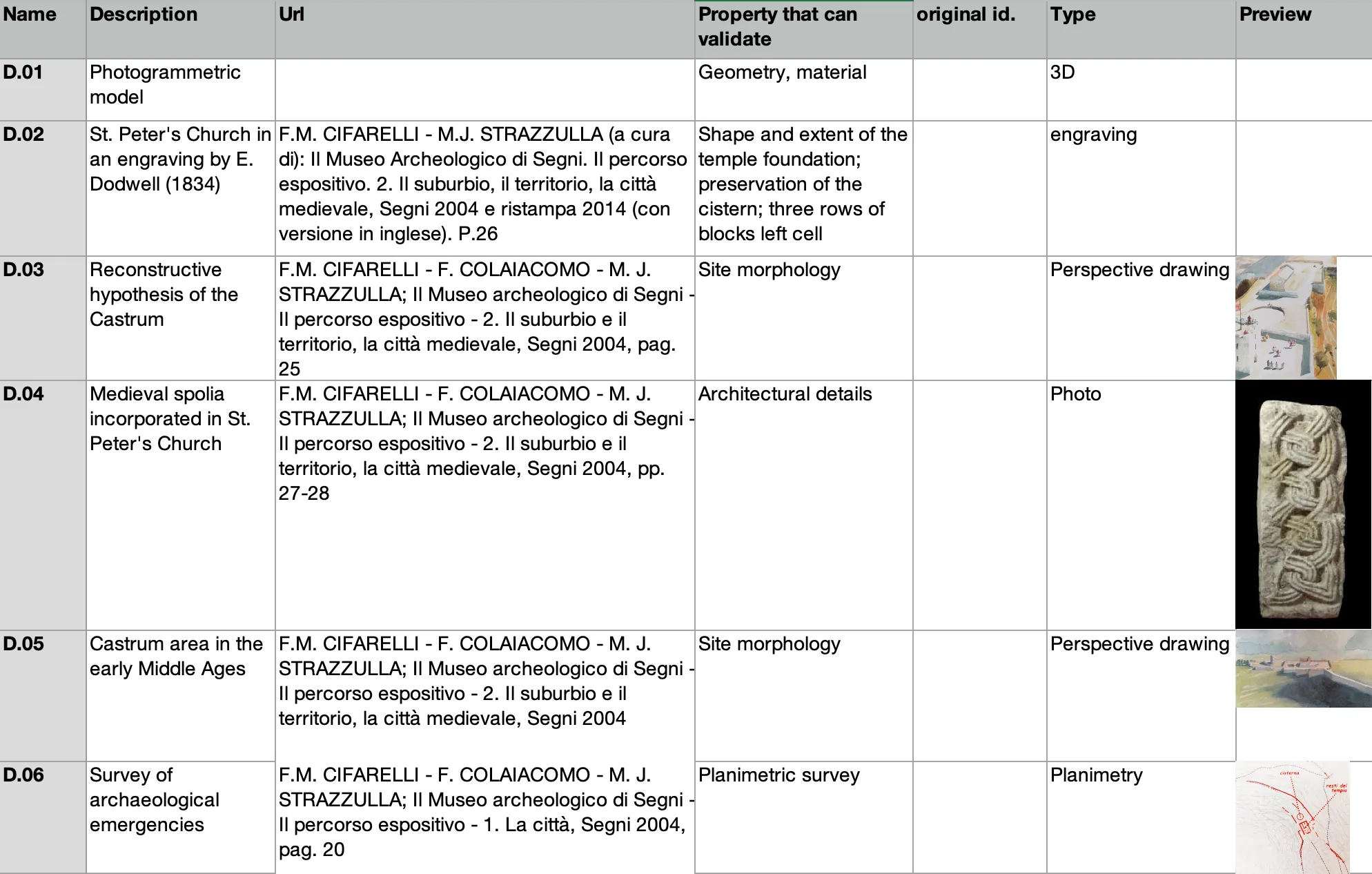
Full column reference and worked example: see the EM manual — Source List schema.
When to use it
- You are starting a new EM project and want to capture the bibliography upfront, before any nodes are drawn.
- You are migrating a legacy project’s sources into EM and need a consistent registry.
- You want every paradata chain in the graph to terminate on a citeable record with a stable id and metadata.
Compatibility
| EM version | Status |
|---|---|
| 1.3 | Original target — formalised as the source list for data collection |
| 1.4 | Fully valid — keep using this template |
| 1.5 | Fully valid — the single-sheet 8-column schema is the supported one |
| 1.6 | Revised schema in preparation: two-sheet split (Analytical / Comparative) + closed Type vocabulary aligned with the DocumentNode three-axis classification — tracked as DP-58 |
Get the template
Use the Download latest button at the top of this page — it
fetches sources_list v.1.3.2.xlsx directly from the
ExtendedMatrix repository.
The legacy filename is kept stable so download links across all the
version-tagged docs and external references keep working: the same
1.3 template is the supported artefact for EM 1.3, 1.4 and 1.5 — the
schema simply did not change across those releases. When EM 1.6 ships
its revised two-sheet schema, a separate file with a cleaner naming
convention will appear alongside (see
DP-58).
The file is shipped as a populated template: 972 real entries from
the Castrum di Segni / St. Peter’s Church project, kept in place so
you can reverse-engineer the column conventions by reading actual
archaeological practice rather than abstract column descriptions.
A README sheet at the front explains how to use it for your own
project — the short version is delete all data rows below the header,
reset the IDs from D.01, and start populating with your own
sources. Per-column help comments are attached to the header cells
of the sources sheet.
How EMtools picks it up
In Blender, EMtools imports source_list.xlsx alongside the GraphML
and the DosCo folder. The Document nodes in the scene’s stratigraphic
graph receive their full metadata from the matching row in the
spreadsheet — so the same D.02 identifier you typed in yEd is now,
inside Blender, a Document node carrying its title, citation,
“properties it can validate” list, and the DosCo file it points at.
The didactic story is: before the import, Document nodes show only
their D.NN identifiers; after the import, they carry the full
descriptive content from the spreadsheet — without any change to the
GraphML itself.
How Heriverse exposes it
When the project is published to Heriverse, the Document metadata you
captured in source_list.xlsx becomes the content of the paradata
pop-ups that visitors see when they click on a reconstructed unit:
the source citation, the validation chain, the link back to the
archival reference. The same registry that drives Blender’s Document
Manager drives the public web scene — no manual re-typing.
Manual & roadmap
- Source List schema (EM 1.5 manual) — column reference and worked example.
- DP-58 — Bibliographic & Archival Sources Template
— design status of the 1.6 revision (two-sheet split, closed Type
vocabulary, integration into
em_data.xlsx).
Shipped in EM versions
One-click download for each combination — or click the EM version number to see its full compatibility matrix.
| Download | EM version | Tool version | Status | Note |
|---|---|---|---|---|
| ⬇ download | EM 1.6 | 1.3 (legacy, still valid) | included | Original source registry template, expected to remain valid in 1.6. |
| ⬇ download | EM 1.5 | 1.3 (legacy, still valid) | included | Source registry template — the structured XLSX file where you catalogue every document that will be cited as evidence in the graph. |
| ⬇ download | EM 1.4 | 1.3 / 1.4 | included | Source registry template — designed for 1.3, fully valid in 1.4. |